The Trench Coat Before It Became Effortless
B
BUYIT Journal· Fashion history notes
A trench coat looks relaxed only because most of its work has become invisible. The belt hangs loose. The collar turns up against wind. The front closes over a shirt, knit, suit, or dress without asking for much attention. It is one of those garments people call timeless when they really mean that its original purpose has been absorbed into ordinary life.
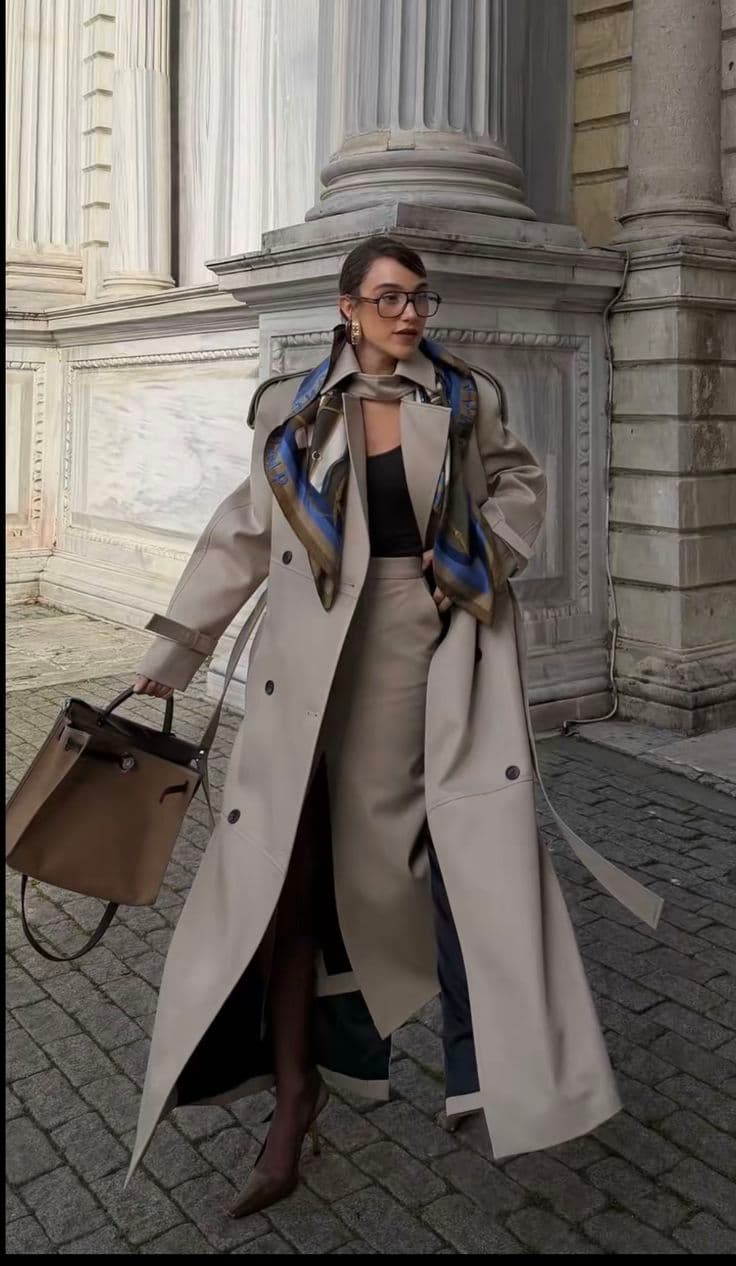
The details still tell the older story. The double-breasted front gives overlap against weather. The belt can pull the coat close to the body. The shoulder straps, storm flaps, throat latch, and deep pockets belong to a world where a coat was equipment before it was a mood. Even the beige cotton surface, so easy to treat as neutral, comes from practical thinking: light enough for visibility, sturdy enough for rain, and plain enough to sit between uniform and civilian dress.
The trench coat developed from late nineteenth-century weatherproof outerwear and became strongly associated with military use during the First World War. Companies such as Burberry and Aquascutum helped define the coat's technical language through treated cotton fabrics and protective construction. It was not originally designed to look mysterious in a doorway. It was made for mud, damp air, movement, and the need to carry things.
That origin explains why the garment still feels active even when worn open over jeans. A trench has a front and a back, but it also has a sense of readiness. The wearer can belt it, button it, push the sleeves up, fold the collar, or let the panels move while walking. The coat never becomes a flat rectangle around the body. It keeps offering small choices.
When the trench moved from military use into civilian wardrobes, it carried authority without looking ceremonial. A tailored wool coat can feel formal. A leather jacket can feel charged. A trench sits somewhere else. It is structured but not stiff, practical but not plain. Film helped sharpen this reading. On screen, the trench could belong to detectives, travelers, people waiting in train stations, people leaving rooms before the truth had settled. The coat looked good in bad weather and better in uncertainty.
What matters for fashion is that the trench turns function into gesture. The belt changes more than closure; it changes proportion. Tied tight, it gives a waist. Knotted behind, it opens the front and makes the coat swing. A raised collar frames the face. A half-buttoned front creates diagonal movement across the torso. The same coat can look guarded in the morning and careless by evening.
The fabric is central to that flexibility. Cotton gabardine, closely associated with the classic trench, is not glossy in the way leather is or soft in the way wool can be. It has a dry, firm hand. It holds a line, then wrinkles from use. A good trench rarely looks better because it is pristine. It looks better when the belt has memory, when the sleeve crease shows where an arm bends, when rain has reminded the cloth what it was made for.
The coat's neutrality is also more complicated than it seems. Beige, khaki, stone, navy, and black all shift the message. Beige keeps the military and travel associations close. Navy makes the coat more urban. Black pulls it toward film and evening. Long length adds drama; shorter length makes it commute-friendly. A soft oversized trench suggests ease, while a crisp fitted one still has the outline of uniform.
That is why the trench survives cycles of trend. This is not simply because people like classics. It survives because it solves several visual problems at once. It gives the body a frame. It works over light or heavy layers. It makes ordinary clothing look more intentional. It handles weather without looking like pure rainwear. Most importantly, it can be styled without becoming the whole outfit.
Modern fashion often treats the trench as an emblem of effortlessness, but the garment is full of effort: engineering, fabric treatment, military history, cinema, and repeated small adjustments by the wearer. The ease comes later, after the coat has done its quiet work. Put one on and the body changes before anything dramatic happens. The shoulders settle. The hands find the pockets. The belt asks whether the day needs structure or movement.
That is the trench coat's real inheritance. It is not just a coat that crossed from war to wardrobe. It is a practical object that learned to look like atmosphere.
The trench also teaches a useful lesson about borrowed authority. Many garments take details from uniforms, but the trench keeps those details in a readable system. Epaulettes, belt, flaps, pockets, and cuff straps all speak the same language: adjust, fasten, protect, carry. Remove too many of them and the coat becomes only a beige overcoat. Keep them, and even a soft modern version remembers why it looks capable.
Its relationship with gender has also shifted. On men, the trench can still carry detective, officer, or commuter codes. On women, it often works as a frame around softer clothes, turning a dress or knit into something more urban. Oversized, it can feel borrowed and protective. Fitted, it becomes sharper and more deliberate. The garment has enough structure to hold both readings without losing its identity.
Related articles
June 17, 2026
June 15, 2026
June 9, 2026
June 1, 2026