The Scarf and the Small Drama of a Moving Square
B
BUYIT Journal· Fashion history notes
A scarf is one of the simplest fashion objects: a length or square of fabric. It can be folded, knotted, wrapped, tied, draped, twisted, or left loose. That simplicity gives it unusual freedom. Unlike a dress or coat, it does not need to fit the body in one fixed way. It can move around the body and change meaning each time.
Scarves have long histories across many cultures and uses: warmth, modesty, labor, rank, religion, military identification, mourning, sport, luxury, and decoration. In fashion, the scarf's power often comes from its ability to add color, texture, and movement without changing the base outfit. It is a small surface with a large effect.
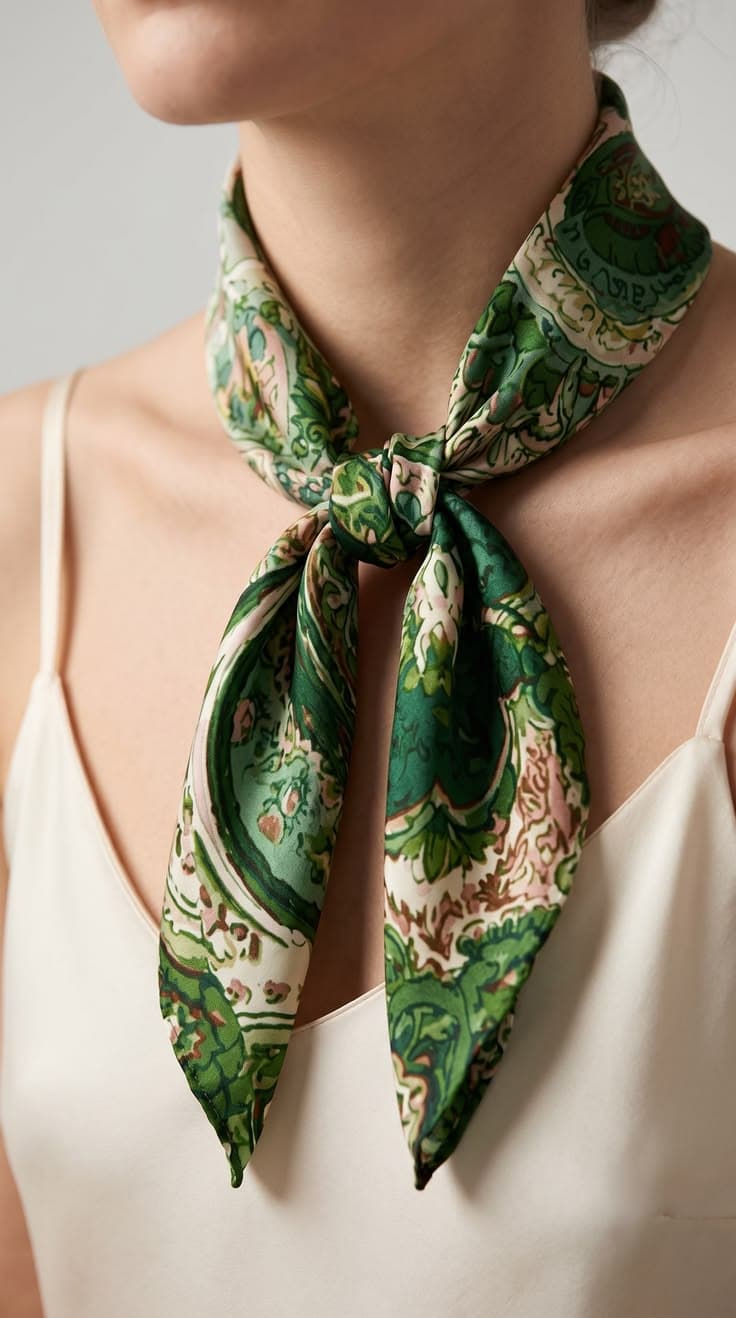
The neck scarf is the most familiar version. Tied close, it frames the face and can feel polished. Left loose, it adds vertical movement. Knotted to the side, it becomes more playful. A silk square can make a plain sweater look intentional. A wool scarf can turn a coat into a winter silhouette. A cotton bandana brings workwear, Western, or street associations depending on color and styling.
The scarf's edge matters. A rolled silk edge, a fringe, a raw hem, a thick knit border, a printed frame: each affects how the cloth behaves. A silk scarf holds color sharply and slides against itself. Wool traps air and creates bulk. Cotton folds flat and stays more matte. Chiffon floats. Cashmere softens. The material decides whether the scarf is line, volume, or atmosphere.
Scarves are also deeply connected to print. A square scarf can carry a whole image: horses, chains, maps, flowers, abstract shapes, logos, borders, scenes. When folded, the image disappears into fragments. The wearer rarely shows the whole design at once. That makes the scarf intimate. It has a complete picture that only partly appears in public.
The scarf can move away from the neck. Tied in the hair, it changes the head. Around a bag handle, it turns a functional object into something personal. Around the waist, it becomes a belt. Worn as a top, it tests the border between accessory and garment. Tied at the wrist, it becomes almost jewelry. The same piece can travel through an outfit during its life.
This mobility is why scarves are useful for personal style. They allow repetition without sameness. A person can wear the same coat all winter and change the scarf to change the mood. A small printed square can bring color to a mostly neutral wardrobe. A long scarf can add drama to simple clothes by moving when the wearer walks.
The scarf also carries ideas of care and gesture. Tying one well takes a moment. The knot may look casual, but it is a decision. Too perfect, and it can seem stiff. Too careless, and the scarf may look accidental. The best scarf styling often looks as if the wearer understands the fabric rather than controls it completely.
In modern fashion, scarves move between luxury and practicality with ease. A silk square may be a collectible object. A winter scarf may be pure necessity. A bandana may be inexpensive and loaded with subcultural meaning. This range keeps the scarf from belonging to one class of dressing.
What makes the scarf endure is that it is adaptable without being empty. It touches the skin, frames the face, catches wind, holds print, and records the hand that tied it. It can be modest or expressive, warm or decorative, polished or improvised.
The scarf's drama is small, but it is real. A square of fabric can change where the eye goes, how color moves, and how finished an outfit feels. It is proof that fashion does not always need a new garment. Sometimes it needs a better knot.
A scarf also changes with season more than many accessories do. In winter, it is insulation and volume. In spring, it may be color at the neck. In summer, it can move to hair, bag, or waist. In travel, it becomes blanket, shade, wrap, or emergency layer. This usefulness gives the scarf a long life outside pure decoration.
The knot can carry cultural memory. A neckerchief knot, a headscarf wrap, a cowboy bandana, a sailor-like tie, a Parisian silk square, a babushka fold, or a loose winter loop all point to different histories. The same piece of cloth can borrow from many of them, which is why styling needs care as well as taste.
Scale is important. A tiny scarf is a color accent. A large square can become a top or head wrap. A long wool scarf changes the vertical line of the body. Oversized scarves can create blanket-like protection, while narrow scarves can feel decorative and almost 1970s.
The scarf is also one of the easiest ways to introduce pattern without committing the whole body to it. A person who would never wear a floral dress may wear a floral square. A print that feels too loud as a blouse can become perfect when folded into a narrow strip at the neck. Scarves make risk adjustable.
They also carry souvenir value. Scarves are bought while traveling, inherited from relatives, saved from old wardrobes, or kept because of a print no longer made. Their flatness makes them easy to store, but their associations can be large. A scarf often remembers a place or person more strongly than a larger garment does.
In styling, the scarf's success depends on not overworking it. A knot that is too fussy can age the outfit quickly. A knot that is too careless may simply fall apart. The best scarf use usually leaves room for movement: a loose end, a soft fold, a bit of asymmetry, a trace of the hand that tied it.
Related articles
June 17, 2026
June 9, 2026
June 1, 2026
May 29, 2026