The Corset That Taught Fashion to Stand Sideways
B
BUYIT Journal· Fashion history notes
Look at a fashionable woman from the early 1900s and try to ignore the hat. It is not easy. The hat is probably wide, feathered, tilted, and large enough to have its own weather. But the stranger detail is lower down: the body itself seems to have been arranged from the side.
The chest leans forward. The stomach looks flat and controlled. The hips sit back. The spine curves into a long, deliberate line. It is graceful, but not relaxed. It looks like a pose that has been practiced in front of a mirror, then held for a photograph.
That shape came from the straight-front corset, now often called the S-bend corset. Today, the name makes it sound like an obvious instrument of distortion. But when this corset entered fashion at the turn of the twentieth century, it did not present itself as a fantasy object. It arrived with a much more respectable promise: health.
One of the figures most closely associated with the straight-front corset was Ines Gaches-Sarraute, a French doctor and corsetiere. She argued that older corsets could place harmful pressure on the abdomen and internal organs, especially when they forced the waist inward and downward. Her proposed solution was a different kind of construction. The front of the corset would be straighter and firmer, supporting the abdomen rather than crushing it. The chest would have more freedom. The body, in theory, would be better held.
This is where fashion took over.
The construction was simple in principle. A rigid busk ran down the front, helping to keep the torso smooth and flat. The corset extended lower over the hips than many earlier versions, controlling the waist and the transition into the skirt. Instead of making the waist the single dramatic point of the body, it stretched attention across the whole profile. The wearer no longer looked merely narrow at the middle. She looked newly arranged: flatter through the front, fuller behind, and visibly shaped before the dress even appeared.
Under clothing, that mattered enormously. A blouse could not simply sit on top of this shape as if nothing had changed. The fashionable bodice often softened and puffed forward over the bust, creating the "pouter pigeon" effect associated with the period. Skirts fell cleanly at the front, then moved into fullness behind. Jackets, dresses, and walking suits were cut for a body that seemed to advance and retreat at once.
The result was the Edwardian S-curve: bust forward, stomach flat, hips back.
On fashion plates, the effect could be almost liquid. Illustrators made the line longer, smoother, and less bound by anatomy. In real life, it varied. Some women wore the silhouette mildly. Some relied on padding to make the bust or hips match the ideal. Some probably looked perfectly ordinary until they turned sideways. That gap between image and reality matters because the most dramatic version is usually the one that survives in memory.
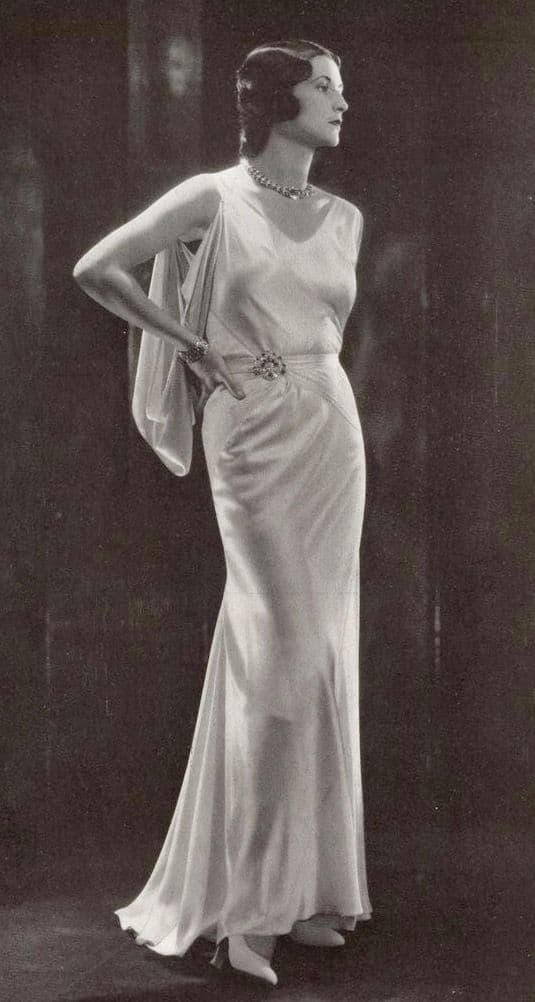
Still, even the practical version changed how women carried themselves. The straight-front corset shaped how a woman stood in a room, how she sat in a chair, how she appeared in a photograph, and how her clothes moved when she walked. In a studio portrait, the pose was not incidental. The dress, corset, stance, and camera angle worked together.
The timing helps explain why the look became so powerful. Around 1900, visual culture loved curves. Art Nouveau filled posters, furniture, jewelry, lamps, and ironwork with stems, vines, hair, smoke, and flowing lines. Fashion picked up the same taste for elongated movement. The S-bend silhouette belonged to that world: decorative, controlled, and slightly unreal.
The contradiction is hard to miss. A garment discussed in the language of health became famous for a posture that looks anything but natural. But that does not make the health argument meaningless. Dress reformers were responding to real discomfort and real medical criticism of older corsetry. The straight-front corset was not invented simply as an aesthetic trick. Its later reputation comes from what happened once manufacturers, magazines, dressmakers, and customers turned the idea into a look.
It would be too easy to laugh at it from a century away. The S-bend can look absurd now, especially in its most exaggerated form. But the logic behind it is still familiar. A garment promises support. A new cut promises ease. A fabric promises comfort. Then the mirror adds another demand: flatter here, longer there, softer here, sharper there. The promise of comfort and the pressure to look right are often sold in the same package.
The straight-front corset also belonged to a period when women's lives were changing faster than fashion could comfortably process. More women were visible in offices, shops, universities, city streets, and public transport. Dress reformers wanted clothing that allowed health and movement. Manufacturers wanted new products. Fashion magazines wanted novelty and beauty. The straight-front corset sat in the middle of those pressures. It sounded modern. It looked elegant. It still controlled the body.
That tension is what makes it interesting. It was not simply the last gasp of Victorian restriction before modern clothing arrived. It was part of the transition. It moved fashion away from the compact hourglass of the nineteenth century and toward a longer, straighter body line. It made the side silhouette important. It prepared the eye for clothes that would soon depend less on the old waist.
By the 1910s, the extreme S-curve began to fade. The fashionable figure became narrower and more vertical. Brassieres became more important. Skirts changed. The waist slowly lost its authority. By the 1920s, the dropped waist and flatter silhouette made the Edwardian curve look like it belonged to another civilization.
But fashion rarely replaces one body ideal overnight. The straight-front corset loosened the visual grip of the Victorian hourglass even while creating a discipline of its own. It did not free the body in any simple way. It changed what kind of control looked current.
That is why its shadow is still visible. Not in everyday corsetry, necessarily, but in the way fashion keeps editing posture. A sculpted blazer can push the chest forward. A dress can smooth the front and build drama at the back. Shapewear can be sold as comfort while quietly redrawing the figure. Runway styling can ask the model to stand in a way no one stands while buying coffee. The tools are different, but the basic request is familiar: let the garment decide what the body should emphasize.
The straight-front corset matters because it makes that request unusually clear. It took support and made it visible. It made the body fashionable from the front and from the side. And it left behind a useful warning: whenever fashion promises to make the body feel better, it is worth asking what shape it also wants the body to perform.
Related articles
June 16, 2026
June 6, 2026
June 5, 2026
June 2, 2026